
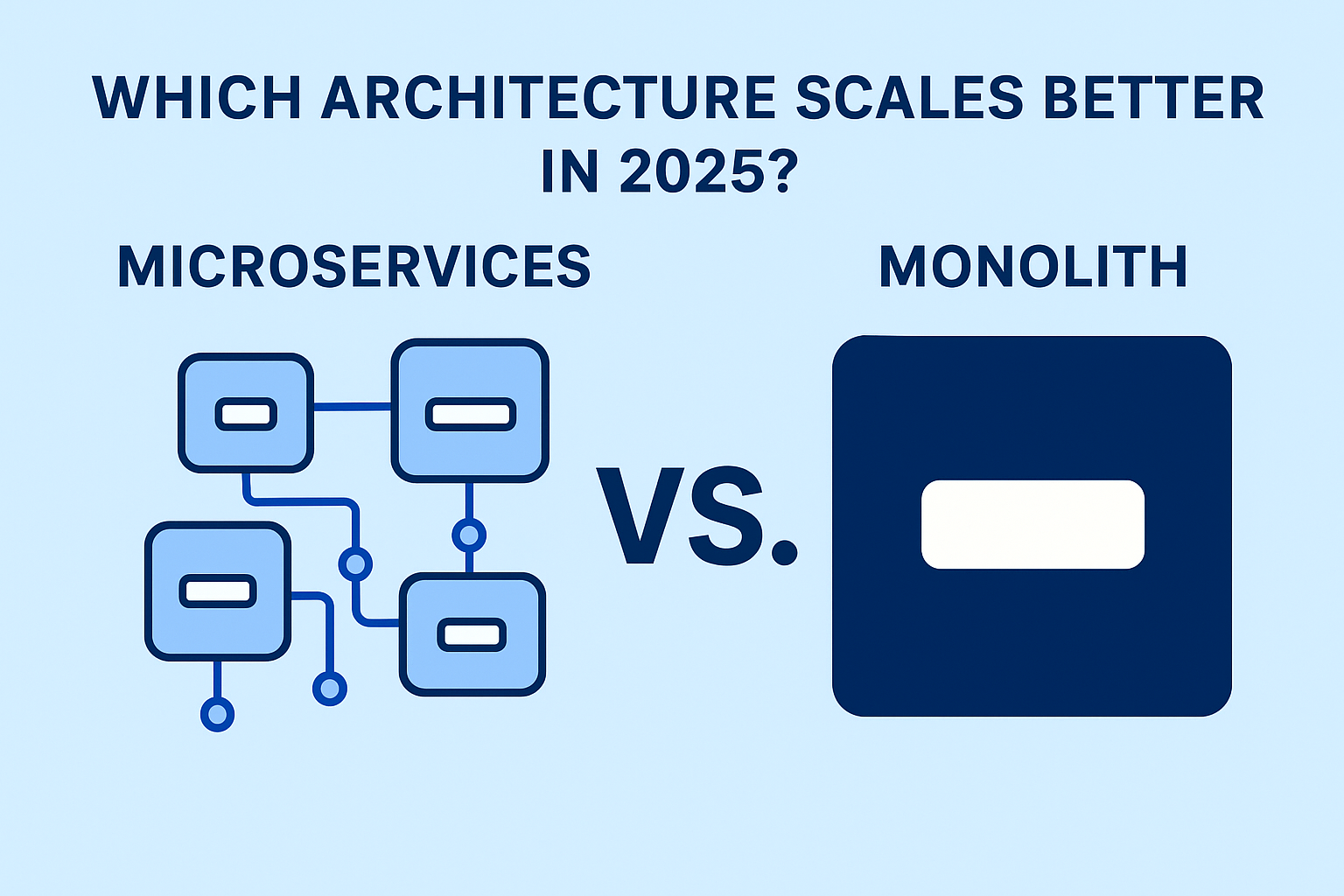
As businesses continue to demand faster innovation, improved performance, and seamless user experiences, choosing the right software architecture has never been more critical. In 2025, the conversation around microservices vs. monolithic architecture remains highly relevant—especially when it comes to scalability. So, which one scales better today? Let’s break it down.
What Is a Monolithic Architecture?
A monolithic architecture is a traditional approach where the entire application—frontend, backend, and business logic—resides in a single, unified codebase.
Advantages
- Simplicity of development and deployment
- Easy debugging and testing due to centralized code
- Lower initial setup and infrastructure cost
Challenges
- Difficult to scale individual components
- Codebase becomes harder to maintain as it grows
- Any change requires redeploying the entire application
- Increased risk of system-wide failures
What Are Microservices?
Microservices architecture breaks an application into smaller, independent services. Each service focuses on a specific function and communicates through APIs.
Advantages
- Scales horizontally with precision—only the services under load are scaled
- Independent development and deployment
- Technology flexibility (use different languages, databases per service)
- Fault isolation minimizes system-wide crashes
Challenges
- Increased complexity—requires managing distributed systems
- Higher infrastructure cost due to multiple services and deployments
- Needs strong DevOps, CI/CD, and monitoring practices
Which Scales Better in 2025?
Winner: Microservices—for most large and rapidly evolving systems
In 2025, platforms like Kubernetes, serverless computing, and service meshes (e.g., Istio, Linkerd) have matured significantly, making microservices more scalable and easier to manage than ever before. Companies aiming to support millions of users, global traffic, and frequent feature updates find microservices the better fit.
However, scalability isn’t just about handling more users. It involves:
- Team scalability: Microservices allow independent teams to work without stepping on each other’s toes.
- Deployment scalability: Release new features without redeploying the entire application.
- System scalability: Scale only what you need—efficient resource usage.
But… Monolith Still Has Its Place
For startups, small applications, or early-stage products, monolithic architecture can be:
- Faster to build and cheaper to maintain
- Ideal for small teams with limited resources
- A better starting point before evolving into microservices
Microservices vs. Monolith: Quick Comparison
| Feature | Monolith | Microservices |
|---|---|---|
| Scalability | Limited, entire system scaled | High, per-service scaling |
| Deployment Speed | Slower, full system redeploy | Fast, independent deployments |
| Complexity | Low | High (requires orchestration) |
| Team Productivity | Slows with team growth | Enables modular team structure |
| Best For | Small apps, MVPs | Large, evolving platforms |
When Should You Choose Microservices?
- You expect rapid growth or global traffic.
- Your application has multiple independent features.
- Your teams are large and distributed.
- You’re equipped with DevOps tools and cloud infrastructure.
When Is Monolith Better?
- You’re building an MVP or early-stage product.
- Your team is small.
- You need speed over complexity.
- You don’t require granular scalability—yet.
Final Thoughts
In 2025, microservices remain the superior architecture for scalability, particularly for medium to large-scale systems. But that doesn’t mean monoliths are outdated—they’re still practical, efficient, and often the smart first step.
The real key? Start with what fits your current needs—and evolve as your application grows.